The OODA Framework for SAP Leaders: Make Better Decisions Faster
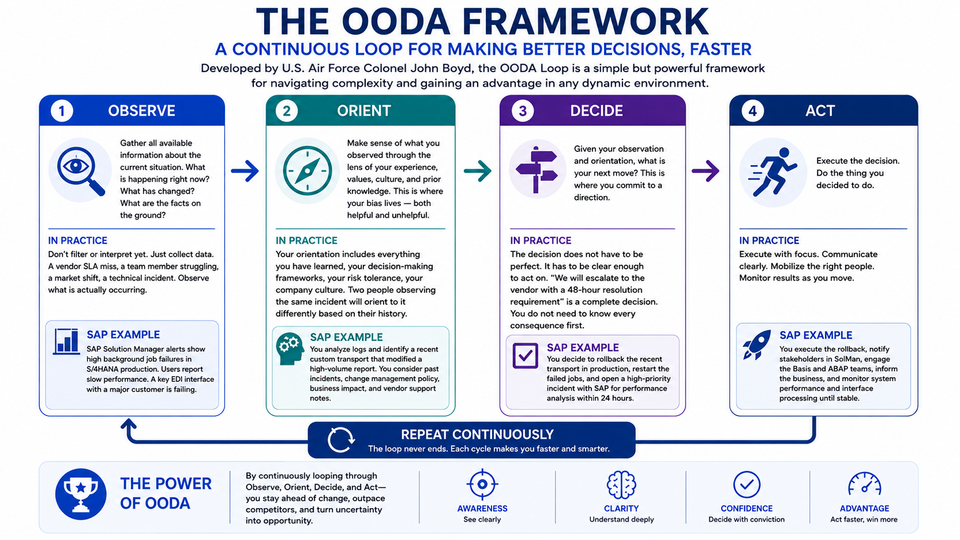
In SAP operations, speed matters. Whether you are dealing with an S/4HANA performance issue, a failed transport, or an EDI outage, leaders are expected to assess the situation quickly and respond with confidence.
One of the most effective decision-making models I have found is the OODA Loop, developed by U.S. Air Force Colonel John Boyd.
OODA stands for Observe, Orient, Decide, and Act.
Observe
Start by gathering facts.
In an SAP context, this may include alerts from SAP Solution Manager or SAP Cloud ALM, failed background jobs, interface errors, and reports from end users.
The goal is simple: understand what is happening without jumping to conclusions.
Orient
Interpret the data using your experience and context.
Consider recent transports, business criticality, past incidents, support notes, and organizational risk tolerance.
Two SAP leaders can look at the same issue and reach different conclusions because they bring different experience and assumptions.
Decide
Choose a clear course of action.
For example: roll back the latest transport, restart affected jobs, and open a high-priority incident with SAP.
The decision does not need to be perfect. It needs to be actionable.
Act
Execute the plan.
Coordinate Basis, ABAP, infrastructure, and business stakeholders. Monitor the outcome and adjust as new information emerges.
Why OODA Works in SAP
SAP environments are complex and constantly changing. OODA provides a disciplined approach for responding to uncertainty with speed and clarity.
The real advantage is not making perfect decisions. It is shortening the time between detecting an issue and taking effective action.
In SAP leadership, those who learn faster and adapt faster consistently outperform those who wait for complete certainty.
Member discussion