SAP Clean Core Architecture: A Practical Guide for Technical Teams
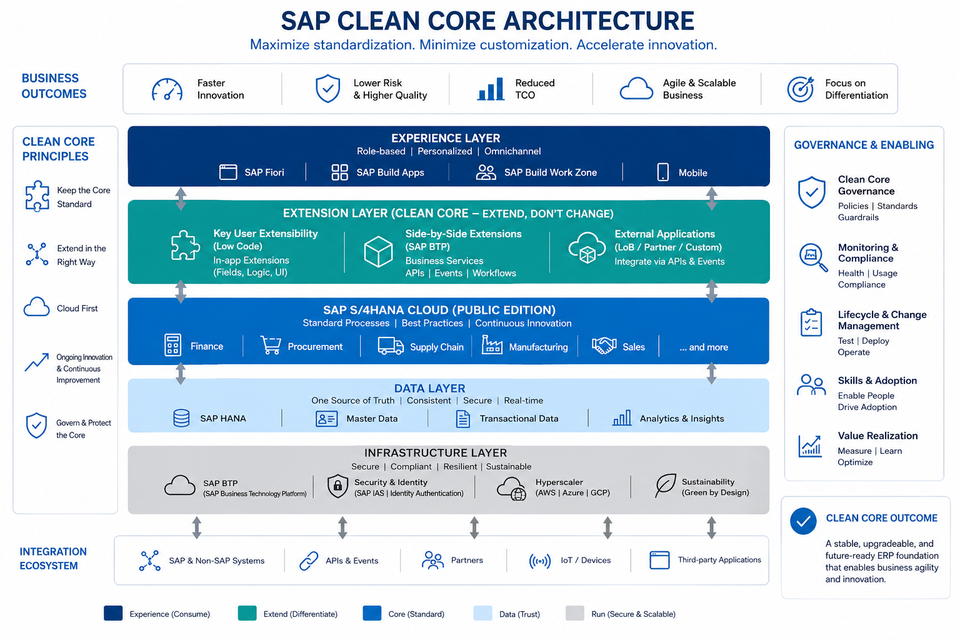
SAP’s Clean Core strategy is a design principle for keeping your SAP S/4HANA system as close to standard as possible while moving custom innovation to the right extension platforms. The goal is straightforward: reduce technical debt, simplify upgrades, and accelerate adoption of new SAP capabilities.
For technical teams, Clean Core is not just an architecture concept. It is an operating model.
What Problem Does Clean Core Solve?
Many SAP landscapes have accumulated years of custom ABAP enhancements, Z-transactions, and tightly coupled integrations. These modifications often create three challenges:
- Upgrades become expensive and risky.
- New SAP features are harder to adopt.
- Support and troubleshooting grow more complex.
Clean Core addresses this by applying one simple rule:
Keep the ERP core standard. Extend, do not modify.
Architecture Overview
The architecture consists of five primary layers.
1. Experience Layer
This is the user interaction layer, typically built with SAP Fiori, SAP Build Apps, and SAP Build Work Zone.
Technical focus:
- Role-based applications
- Mobile access
- Personalized UX
This layer consumes APIs and business services rather than direct custom code in the core.
2. Extension Layer
This is where innovation happens.
Using SAP Business Technology Platform, teams build:
- Side-by-side applications
- Event-driven integrations
- Workflow automations
- APIs and microservices
In-app extensibility remains available for approved low-code enhancements such as custom fields, business rules, and UI adaptations.
3. SAP S/4HANA Core
SAP S/4HANA remains the transactional backbone.
Technical principles:
- Use standard business processes.
- Minimize modifications and implicit enhancements.
- Favor released APIs and CDS views.
- Adopt SAP Best Practices.
The core should contain only what SAP delivers and what is required to run the business using supported extensibility mechanisms.
4. Data Layer
Powered by SAP HANA, this layer manages:
- Master data
- Transactional data
- Operational analytics
A clean core improves data consistency and simplifies downstream reporting through platforms such as SAP Business Data Cloud, Snowflake, or Microsoft Fabric.
5. Infrastructure Layer
The foundation includes:
- SAP BTP
- SAP Cloud ALM
- SAP Cloud Identity Services
- Hyperscalers such as Microsoft Azure, Amazon Web Services, and Google Cloud
This layer provides security, monitoring, compliance, and resilience.
Governance Is the Critical Enabler
Technology alone does not guarantee a clean core. Governance is essential.
Technical governance should define:
- Approved extension patterns
- API and integration standards
- Custom code review criteria
- Transport and release controls
- Usage and compliance monitoring
Tools such as SAP Cloud ALM and SAP Custom Code Migration help measure adherence.
Outcomes for Technical Teams
When implemented well, Clean Core delivers measurable benefits:
- Faster upgrades with fewer retrofit efforts
- Reduced custom code inventory
- Lower support overhead
- Better system stability
- Faster adoption of AI and new SAP innovations
Final Thought
Clean Core is a strategic architecture discipline. It separates standard ERP capabilities from differentiated business innovation. For technical teams, this means less time maintaining custom code and more time building scalable solutions on SAP BTP.
The result is an SAP landscape that is upgradeable, extensible, and ready for continuous innovation.
Member discussion