Better Prompts, Better Outcomes: Using the CO-STAR Framework
One of the most valuable skills in the age of AI is not knowing all the answers. It is knowing how to ask better questions.
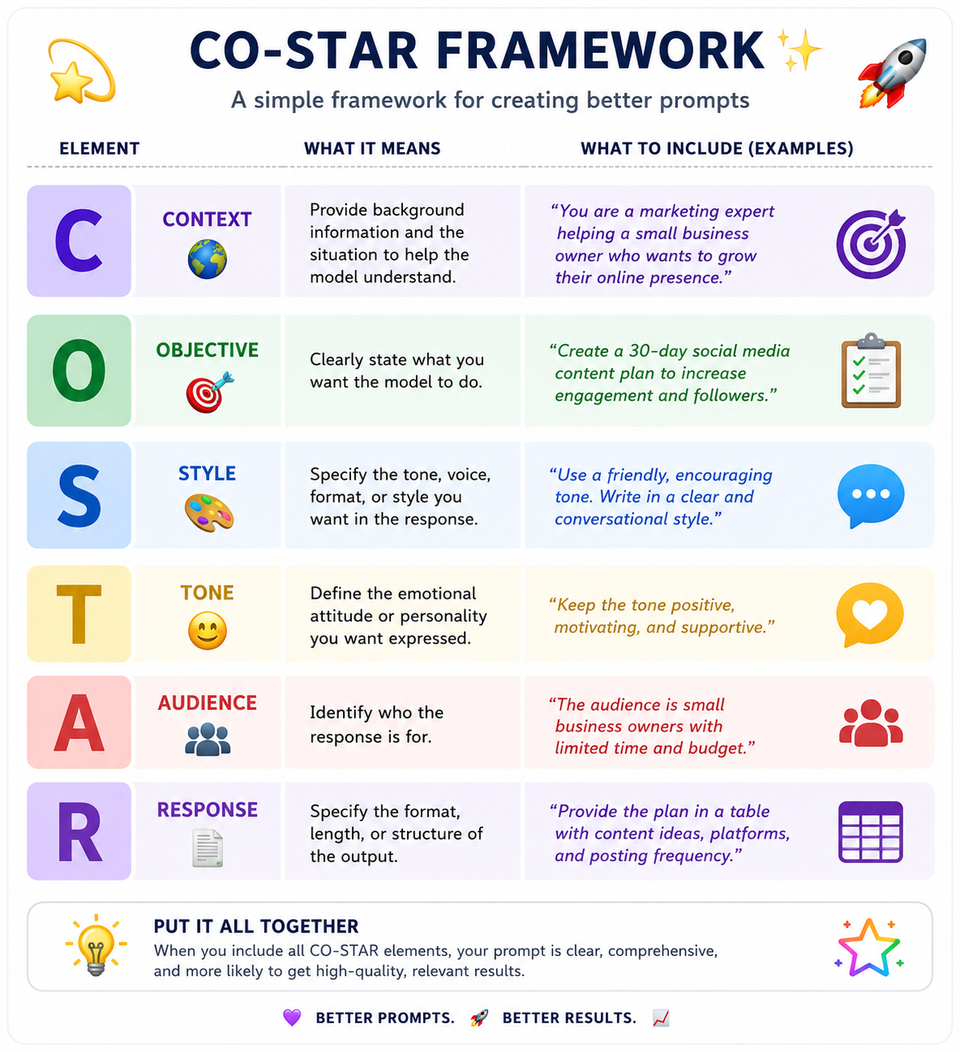
Whether you’re using AI to draft communications, analyze data, create project plans, or summarize complex information, the quality of the output is directly influenced by the quality of the prompt. A simple framework I have found useful is CO-STAR.
C: Context
Provide background information. What situation is the AI helping with? Context reduces assumptions and improves relevance.
O: Objective
Clearly define what you want accomplished. The more specific the objective, the more focused the response.
S: Style
Specify the format or approach. Do you want an executive summary, a technical analysis, a presentation outline, or a step-by-step guide?
T: Tone
Describe how the response should sound. Professional, conversational, persuasive, educational, or concise all produce very different results.
A: Audience
Identify who will consume the output. A response intended for executives should look different from one written for developers or end users.
R: Response
Define the desired output structure. For example, a table, bullet list, roadmap, action plan, or one-page summary.
The CO-STAR framework is valuable because it forces clarity before execution. In many cases, the exercise of building the prompt helps refine your own thinking before the AI generates a response.
As technology leaders, we spend much of our time translating business needs into actionable outcomes. Prompt engineering follows the same principle. The clearer the inputs, the better the results.
AI is not replacing critical thinking. It is amplifying it. Frameworks like CO-STAR help ensure that amplification produces useful, relevant, and actionable outcomes.
A simple takeaway: before submitting your next prompt, spend 30 seconds checking whether you’ve covered all six CO-STAR elements. The improvement in output quality is often significant.
Member discussion